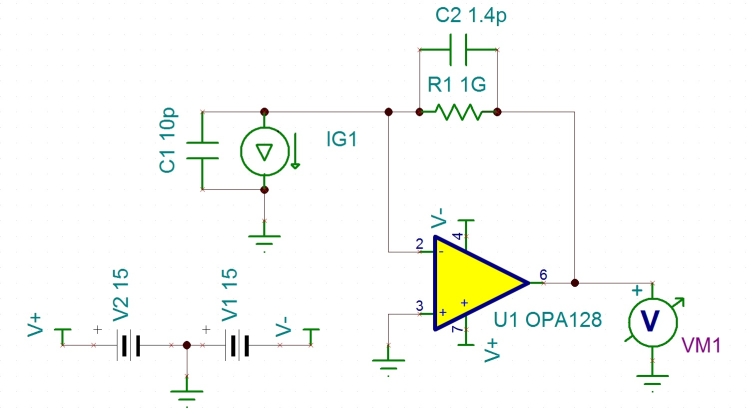
The tunnelling current amplifier is an example of a transimpedance amplifier: it converts a current input into a voltage output. This amplifier is a critical circuit in the microscope, so I have taken advantage of available electronic simulation software (TINA-TI version 9, free to download from Texas Instruments) to test and tune the design before committing to a PCB. I have a choice between a simple, 'classic' transimpedance amplifier and a more complex - but possibly better performing - 'composite' amplifier.
In a transimpedance amplifier there is an unavoidable tradeoff between the bandwidth of the amplifier response and its output noise. The higher the bandwidth of the amplifier, the faster the response, but also the higher the output noise will be. These two parameters have the following effects on the microscope performance:
The design of the tunnelling current amplifier is guided by the following questions:
The 'classic' transimpedance amplifier design for small currents such as photodiodes etc is an op-amp with negative feedback via a single large value resistor, with a compensation capacitor to prevent oscillation due to noise gain:
R1 is the feedback resistor, C2 is the compensation capacitance (including the parasitic capacitance of the resistor itself). C1 represents the parasitic capacitance of the current source IG1. The output of the circuit is nominally is 1V/nA.
Assuming 10pF capacitance for the tunnelling signal input, and using only the parasitic capacitance of the feedback resistor for compensation (around 0.3pF for a leaded resistor), the 3dB bandwidth is about 520 Hz - not great, but possibly usable. The output noise looks to be around 200uVrms.